To move a washing machine safely, disconnect it, drain every drop of water, fit the transit bolts, and carry it upright with at least two people. Then level it, reconnect the hoses and run a test cycle in your new home. The whole job takes about 1 to 2 hours if you prepare well.
Moving house in London adds a few extra challenges. Many homes have narrow hallways, steep stairs, or flats with no lift. A washing machine can weigh 60 to 90 kg, so a bad lift or a leaking hose can damage the machine, your floors and your back.
This guide walks you through each step in plain English. You will learn how to prepare the machine, protect the drum, move it safely, set it up again, and what it costs if you hire professionals in London.
Quick Summary: The 8 Steps
- Switch off and unplug the machine.
- Turn off the water supply and disconnect the hoses.
- Drain the machine and the filter.
- Clean it and let it dry.
- Fit the transit bolts (or secure the drum).
- Lift it upright with a helper and a trolley.
- Strap it in place in the van.
- Level, reconnect and test it in your new home.
What You Need Before You Start
- Towels and a shallow tray or baking dish
- A bowl or bucket
- Adjustable spanner or pliers
- Your washing machine manual (or find it online by model number)
- The original transit bolts, or spare ones from the manufacturer
- Ratchet straps and a sack truck or appliance trolley
- Blankets or moving pads
- A spirit level (for the new home)
- Cable ties or tape
1. What to Do Before Moving a Washing Machine
Before moving a washing machine, unplug it, turn off the water, disconnect the hoses and drain all remaining water. Skipping any of these steps is the most common cause of leaks and floor damage on moving day.
Do this the day before the move, so the machine has time to dry.
Disconnect the Water Supply
Turn off the water supply to the machine first. Look for a small valve or tap behind or beside the washer, often under the kitchen worktop. Turn it a quarter turn so the handle sits across the pipe.
Then unplug the machine from the socket. Never work on a washing machine that is still connected to power.
Unscrew the inlet hose from the machine and from the tap. Hold it over your bowl, because some water will run out. Some machines have two inlet hoses (hot and cold), so check both.
Drain All Remaining Water
A washing machine always holds some water, even after a cycle. Draining it protects your floor and the machine’s inside parts.
- Lay towels on the floor and put a shallow tray under the drain filter.
- Open the small flap at the bottom front of the machine.
- Unscrew the filter slowly. Water will flow out, so be ready to catch it.
- Some machines have a small emergency drain tube next to the filter. Pull it out and let it empty into a bowl.
- Clean fluff, coins and hair from the filter, then screw it back in.
- Lower the drain hose below the machine and let any water run into the bowl.
If your machine door is locked, switch the power on, run a short drain or spin cycle, then switch it off again. Check your manual if the door will not open.
Remove and Secure the Hoses
Pull the drain hose off the waste pipe or standpipe. Let it empty fully. Then:
- Coil the hoses and tie them with cable ties.
- Place them inside the drum or tape them to the back of the machine.
- Wrap the power cable and tape it down so nobody trips on it.
If the hoses are old, cracked or stiff, buy new ones for your new home. They are cheap and reduce the risk of leaks.
Clean and Dry the Washing Machine
Wipe the drum, door seal, detergent drawer and outside of the machine. Leave the door and drawer open for at least a few hours (or overnight) so everything dries. A damp machine can smell musty by the time you set it up again.
2. How to Secure a Washing Machine for Transportation
Secure a washing machine by fitting its transit bolts, which lock the drum in place so it cannot swing and damage the suspension, bearings and shock absorbers. If you do not have the bolts, you have other options.
Why Washing Machine Transit Bolts Matter
Inside the machine, the drum hangs on springs and shock absorbers. This lets it shake during a fast spin without wrecking the machine. During a move, that same freedom is a problem. Bumps in the van can make the drum slam against the casing.
Transit bolts (also called shipping bolts) hold the drum still. Most front-loading machines come with two to four of them, fitted at the back. They are often removed when the machine is first installed and kept in the box or a drawer.
What if you moved a washing machine without transit bolts? You may be fine for a short, careful journey, but the risk of damage goes up. Common problems include loud banging, heavy vibration, leaks and a drum that no longer spins properly. Check the machine on its first cycle and call a repair engineer if something seems wrong.
Do you have to use them? Most manufacturers say yes. Check your manual. Washer-dryers and some top-loaders have different systems, so follow the instructions for your model.
How to fit transit bolts
- Find the holes in the back of the machine where the bolts were originally fitted.
- Push the plastic spacers (if your model has them) into the holes.
- Screw in the bolts and tighten them firmly with a spanner.
- Check that the drum no longer moves freely by gently pushing it.
Can’t find yours? Search online with your brand and model number. Most major brands sell replacements. In London, many appliance repair shops also stock them.
How to Protect the Drum
If you have lost the transit bolts and cannot buy new ones, you can add some protection:
- Fill the drum with towels or soft clothes so it cannot move around.
- Wrap the machine in a moving blanket.
- Drive carefully and avoid heavy braking.
This is not as good as proper transit bolts, so treat it as a back-up plan only.
Protecting the Exterior and Pipes
- Tape the door shut with painter’s tape, not strong tape that can pull off paint.
- Cover corners and edges with blankets or cardboard.
- Keep the hoses and power cable tied up and tucked away.
- Use bubble wrap or a blanket over the control panel.
3. How to Move a Washing Machine Safely
Move a washing machine upright, with two or more people and a sack truck or appliance trolley, and keep it strapped so it cannot tip. Never drag it, and never carry it alone.
How Heavy Is a Washing Machine?
Most household washing machines weigh between 60 and 90 kg. A washer-dryer can be heavier. Check your model’s weight on the label or in the manual. Health and safety guidance on manual handling says you should avoid lifting very heavy loads without help or equipment, so use a trolley wherever possible.
Moving a Washing Machine Upstairs and Downstairs
Stairs are the riskiest part of the job. Many London houses and Victorian conversions have narrow, steep staircases, so plan this before moving day.
- Use at least two strong people. Three is safer if the stairs have tight turns.
- Strap the machine to a sack truck with a ratchet strap.
- Going down, the stronger person stands lower and takes the weight. Move one step at a time.
- Going up, the stronger person is at the bottom, pushing and lifting.
- Keep the machine upright and close to your body.
- Stop and rest if it gets heavy. Never rush.
Measure the stairs, doorways and turns first. If the machine will not fit, you may need to remove a door from its hinges.
Using a Washing Machine Trolley
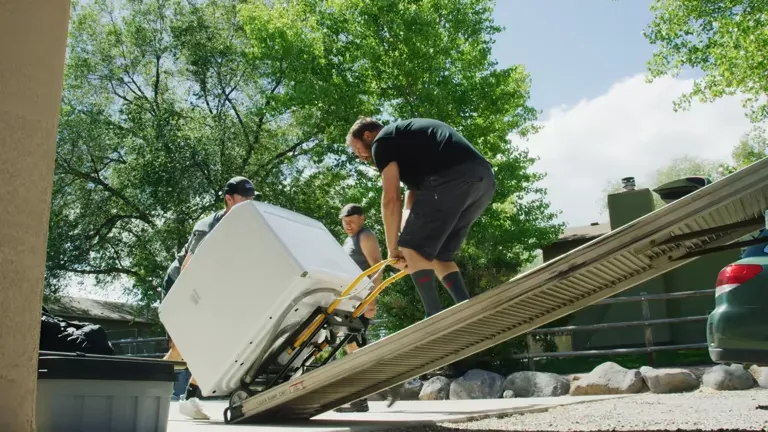
A sack truck or appliance dolly with straps makes a big difference. It takes most of the weight and lets you move the machine across floors without scratching them.
- Tip the machine slightly back onto the trolley.
- Strap it firmly around the middle.
- Pull the trolley backwards on stairs, one step at a time.
- Place cardboard or a rug under the wheels to protect wooden or tiled floors.
You can hire an appliance trolley from many DIY stores or tool hire shops.
Moving Through Narrow Doors and Hallways
Standard washing machines are about 60 cm wide, but London flats and terraced homes often have narrow doorways and tight corners.
- Measure the machine and every doorway and hallway on the route.
- Take doors off their hinges if you need an extra few centimetres.
- Remove the detergent drawer to make the machine slightly lighter.
- Turn the machine sideways only if it stays upright. A narrow gap is easier to pass if you tilt it slightly on a trolley.
- Put down protective floor sheeting or old blankets.
If the machine is built into kitchen units, slide it out slowly and watch for the hoses. Check what the standpipe, waste pipe and sockets look like so you can set up in the new home easily.
Transporting a Washing Machine in a Removal Van
Put the machine in the van last in and first out if possible, or load it against the side wall so it does not move.
- Keep it upright in the van.
- Secure it with ratchet straps to the van’s load rails.
- Put blankets between it and other items.
- Never stack heavy boxes on top.
- Keep it away from loose items that could fall and dent it.
If you are using a hired van, check you can park close to your home. In London, you may need a parking permit, a suspended parking bay or a short loading stop. Contact your local council in advance for a parking suspension if you need one.
4. Can You Transport a Washing Machine on Its Side?
It is best to transport a washing machine upright. If you must lay it down, lay it on its back or side with the transit bolts fitted, and never on the door. Check your manual first, because rules differ between makers.
Why upright is safer: the drum, springs and dampers are designed to work in an upright position. Laying the machine on its side can shift internal parts and, in some models, let fluid in the shock absorbers move out of place.
If laying it down is the only option:
- Fit the transit bolts first.
- Lay it gently on its side or back, never face down on the door.
- Pad it well with blankets.
- When you arrive, stand it upright and wait a few hours before using it. Some manufacturers recommend up to 24 hours.
5. How to Install a Washing Machine in Your New Home
To install a washing machine, place it where the water and waste connections are, remove the transit bolts, connect the hoses, level it, and run a test cycle with no clothes.
Remove the Transit Bolts First
This is the step many people forget. If you try to use the machine with the transit bolts still in, it will shake violently and could be damaged. Remove them, fit the plastic hole covers (if provided), and store the bolts somewhere safe for your next move.
Reconnecting the Water Supply
- Check that the water tap or valve is turned off.
- Connect the inlet hose to the tap and then to the machine. Hand-tighten, then add a small extra turn with pliers if needed.
- Use a new rubber washer if the old one looks worn.
- Turn the water on slowly and check for drips.
Connecting the Drain Hose
Push the drain hose onto the standpipe or the waste connection under the sink. The hose is usually set at a height of roughly 60 to 100 cm, but check your manual. Make sure it is not kinked or squashed behind the machine.
If the hose is too low, water can siphon out. If it is too high, the machine may not drain properly.
Levelling the Washing Machine
A wobbly machine is a noisy, shaky machine.
- Place a spirit level on top of the machine.
- Adjust the feet by twisting them up or down.
- Check it front to back and side to side.
- Tighten the lock nuts on the feet if there are any.
- Rock the machine gently. It should not wobble.
When Can You Use It Again?
If the machine stayed upright the whole time, you can usually use it as soon as it is level and connected. If it travelled on its side, wait a few hours (up to 24 hours for some brands) before turning it on.
Run a short, empty cycle first. Watch for leaks around the hoses, door and filter. Listen for banging or grinding.
6. Common Washing Machine Moving Mistakes to Avoid
The most common mistakes are forgetting the transit bolts, leaving water inside, lifting without help and not checking the doorways. Here is a quick checklist.
| Mistake | What can go wrong | Fix |
|---|---|---|
| Skipping transit bolts | Drum damage, loud noise, leaks | Fit them or pad the drum well |
| Leaving water inside | Leaks in the van, floor damage | Drain the filter and hoses |
| Moving it on its front | Internal damage | Keep it upright or on its side or back |
| Lifting it alone | Back injury, dropped machine | Use two people and a trolley |
| Not measuring doors and stairs | Machine stuck, damaged walls | Measure everything first |
| Forgetting to remove transit bolts at the new home | Violent shaking, damage | Check the back before your first wash |
| Using old hoses | Leaks | Replace them with new ones |
| Not levelling the machine | Noise and vibration | Adjust the feet with a spirit level |
7. How Much Does It Cost to Move a Washing Machine in London?
Moving a washing machine in London usually costs from around £50 to £150 for a single-item job, and more if there are stairs, long distances or extra services. These are rough, indicative ranges. Prices vary by company, area and time of year, so always get a written quote.
| Option | Typical cost (indicative) | Best for |
|---|---|---|
| Do it yourself (van hire, trolley, straps) | Van hire plus trolley hire and fuel | Ground floor, short distance, strong helpers |
| Man and van (single item) | Around £50 to £150 | One or two appliances |
| Full house removal service | Included in your overall quote | Whole-home moves |
| Appliance disconnection and installation | Extra fee, often charged separately | People who want it set up for them |
Things that can change the price:
- Number of floors and whether there is a lift
- Distance across London
- Parking and congestion
- Number of movers needed
- Extra services such as disconnecting, reconnecting or taking away an old machine
- Time of day and day of the week
Always ask whether disconnection and reconnection are included. Many removal firms will move a machine you have already prepared, but plumbing work may need a qualified person.
8. Should You Hire Professional House Removal Services in London?
Hire professionals if you have stairs, a tight space, a heavy machine or a busy move day. Experienced movers have the straps, trolleys and training to handle heavy appliances without damage.
It may be worth it if:
- You are moving from or to a flat with no lift
- Your hallway, stairs or doors are narrow
- You are moving lots of items at once
- You have back problems or no one to help
- You want your belongings insured during the move
- Parking is difficult
What to Ask a Removal Company
- Do you move washing machines and other appliances?
- Will you disconnect and reconnect it, or do I need to?
- Is my appliance covered by your goods-in-transit insurance?
- Do you charge extra for stairs or long carries?
- Can I get a fixed quote in writing?
Some companies will move the machine if you have prepared it, but they may not do any plumbing. If your machine is plumbed into units, you may want a qualified plumber or appliance installer.
Moving Other Appliances at the Same Time
The same rules apply to many household appliances:
- Tumble dryer: Empty the water container, clean the filter and keep it upright.
- Washer-dryer: Treat it like a washing machine, but expect more weight. Check the manual for transit bolts.
- Dishwasher: Drain the filter and hoses, and secure the racks and door.
- Fridge freezer: Empty and defrost it the day before. Keep it upright and let it settle for several hours before switching it on.
- Chest freezer: Defrost and dry it, and secure the lid with tape.
Always read each appliance’s manual, since the rules differ between models.
Frequently Asked Questions
1. How do you move a washing machine to a new house?
Disconnect it, drain all the water, fit the transit bolts, carry it upright with two people and a trolley, and strap it in the van. At your new home, remove the bolts, level the machine and reconnect the hoses.
2. Do you need to drain a washing machine before moving?
Yes. Drain the filter, the drain hose and the inlet hoses. Water left inside can leak in the van and cause damage.
3. Can you move a washing machine without transit bolts?
You can, but it is risky. The drum can bang against the casing and damage the suspension. Buy replacement bolts for your model, or pad the drum with towels and drive carefully.
4. Can a washing machine be transported lying down?
It is safest to move it upright. If you have no choice, lay it on its side or back, never on the door, with transit bolts fitted. Stand it upright for a few hours before use.
5. How long should a washing machine stand after moving?
If it travelled upright, you can often use it once it is level and connected. If it was on its side, wait a few hours, and up to 24 hours if your manufacturer says so.
6. Should you disconnect a washing machine before moving house?
Yes. Always disconnect it from power, water and the waste pipe, and drain it before you lift it.
7. Can removal companies disconnect washing machines?
Some can, but not all. Many firms will move a washing machine you have already disconnected. Ask your removal company before moving day, especially if the machine is plumbed into units.
8. How do you secure a washing machine in a removal van?
Keep it upright, pad it with blankets and fix it with ratchet straps to the van’s load rails or the wall of the van. Do not stack heavy items on top.
9. How do you move a washing machine up stairs?
Use a sack truck with straps and at least two people. Keep the machine upright, move one step at a time and rest when needed. A third person can guide from the side.
10. How much does it cost to move a washing machine in London?
As a rough guide, a single-item move in London often costs between £50 and £150. Stairs, distance and extra services such as reconnection can raise the price. Always get a written quote.
Conclusion
Moving a washing machine is not hard, but it is easy to get wrong. Switch off the power and water, drain the machine, fit the transit bolts, lift it upright with help, and take your time on stairs. At your new place, level it, reconnect the hoses and run a test cycle before your first full load.
If you are moving in London and want one less thing to worry about, a professional removal team can take care of heavy appliances, tight stairs and parking for you. Get a free quote for your London house move or talk to our team about moving appliances and we will help you plan the safest way to move your washing machine.